Streetwear has never been shopping in low stakes places. Skate boards made it rebellious, basketball courts made it cool, and the casino made it a little more glossy: instant shorthand risk, luck and reward. Aces, dice and chip stacks are now on tees and chains as comfortable as any box logo.
The traffic between lobby and lookbook is no longer one-way. Across the United Kingdom, fans finish a quick registration, use one sign in, and open the JeetCity official site, where the official website styling of the JeetCity casino mirrors drop-day graphics — a single login and the Jeet City online casino shows GB players how much lobby design owes to streetwear.
The UK Scene: Grime, Tables and Trainers

Britain assigns the crossover its accent. Grime created a uniform of tracksuits, Air Max and technical jackets, and the older casuals tradition showed that the terrace style could out-dress any dress code. The late-night casinos of London have long been a part of that after-dark circuit.
The mixing of the capital occurs after midnight. A Soho casino floor on a Friday is like a street-style gallery: Stone Island badges next to old Moschino, box-fresh trainers under bespoke overcoats.
The digital rooms inherited the door policy, minus the queue. A quick registration opens the door in GB: fans visit Mond casino through the official website, where login and sign in take seconds and the Mond online casino dresses its tables for the United Kingdom the way the Mond casino floor once dressed its hosts.
The Card Deck as a Print Library
Designers consider the deck an open-source library. Spades and aces anchor graphic tees, dice are suspended on silver chains, and the number seven is more employed in embroidery than most brand names.
The attraction is pragmatic as well as amorous. Card symbols come loaded with meaning, read immediately in any language, and print clearly at any size – a graphic designers dream house. Since the tattoo-flash decks of Ed Hardy in the 2000s to the current gothic-lettered Lucky hoodies, the motif continues to reshuffle instead of retire.
The theme is carried as far as accessories. Dice have been rolled into keychains, beanie charms and even furniture collaborations, and poker chips are reused as belt hardware and lace-locks whenever a collection needs a wink of danger.
Film maintains the reference bank. The pastel suiting of the Casino by Scorsese is still being dissected in menswear forums, and each awards season someone rediscovers the tuxedo as high-roller formal. Tailoring of the Ocean-era did the same to a younger generation, bending heist glamour into smart-casual.
Why High Rollers Dress Loud
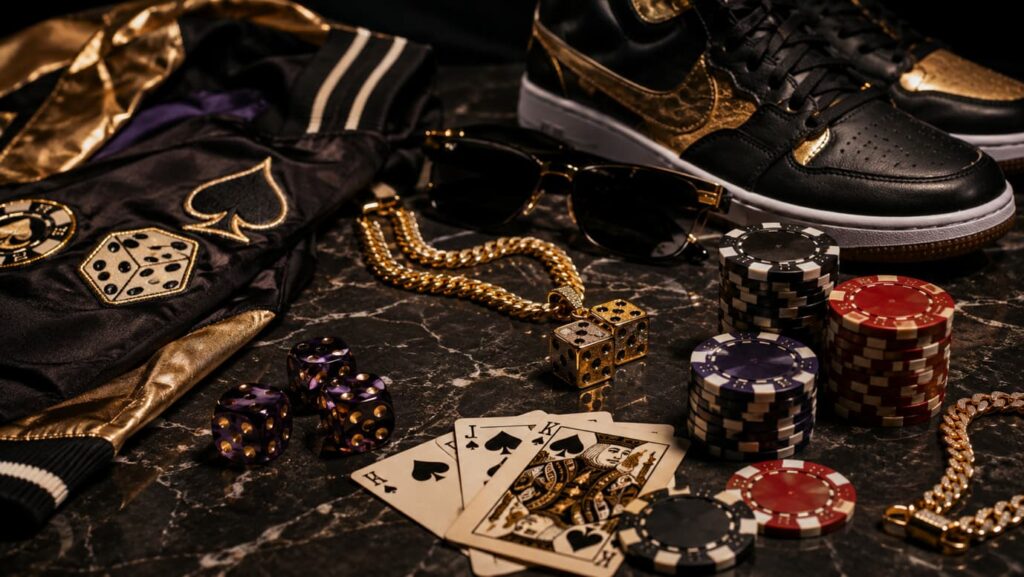
The high roller is the favourite character in streetwear as he dresses to be read across a room. Monogram, gold and logo repetition all convey the same message: the bet paid off.
Psychologists of style refer to it as expensive signalling; the culture simply refers to flexing. A rare colourway is a tall chip stack, evidence of access and not spending. The appearance reduces the price ladder as well, as a lucky-number tee performs the task of a monogram trunk at a fraction of the purchase price.
Lucky rituals also nourish the wardrobe. Fortune socks, dirty winning jerseys and jade or evil-eye charms blur superstition into style, which is precisely the place of casino culture.
Womenswear runs the same play with different pieces. Marabou trims, rhinestone mesh and opera gloves keep returning under names like casino glamour, styled against trainers to keep the street in streetwear.
From Velvet Ropes to Drop Queues
The two cultures were raised on opposite shores of the same notion: exclusivity as theatre. The velvet rope, the comped suite and the dress code were perfected in mid-century Las Vegas, which sold entry as a luxury good. Streetwear transformed the sidewalk in front of a store into the same stage decades later.
The timeline backs the kinship up. As Wikipedia’s overview of streetwear traces, the movement rose from Los Angeles surf-and-skate labels and New York hip-hop before Japanese designers refined it into a collector’s game of scarce releases. Scarcity, the casino’s oldest trick, became fashion’s newest one.
The partnership was cemented by photography. Frames of paparazzi of rat-pack Vegas and, subsequently, of rappers at Monte Carlo tables provided stylists with a reference wall that never actually fell.
Even the words were transferred. A drop is a limited release, a purchase slot is a hit, and a miss is a bad beat. House rules now is on shop signage without a trace of irony.
Resale Culture Is a Betting Floor
Any evidence that the two worlds have a nervous system is resale. Purchasing a hyped pair at retail is a bet; the after-market determines whether the hand was won.
Platforms monitor bids, asks and price charts similar to a bookmaker screen, and StockX even called itself a stock market of things. Raffles made the gamble official, requiring participants to bet their time and data in order to win the right size.
Even limited drops generate volatility of their own, and the market will spike on rumour and correct on news of a stock-out, market behaviour that any trader would be familiar with. Collectors discuss possessing a shoe as traders possess a position, and the language of odds suits fashion so well that no one ever thinks of translating it any more.
Digital Lobbies, Digital Wardrobes
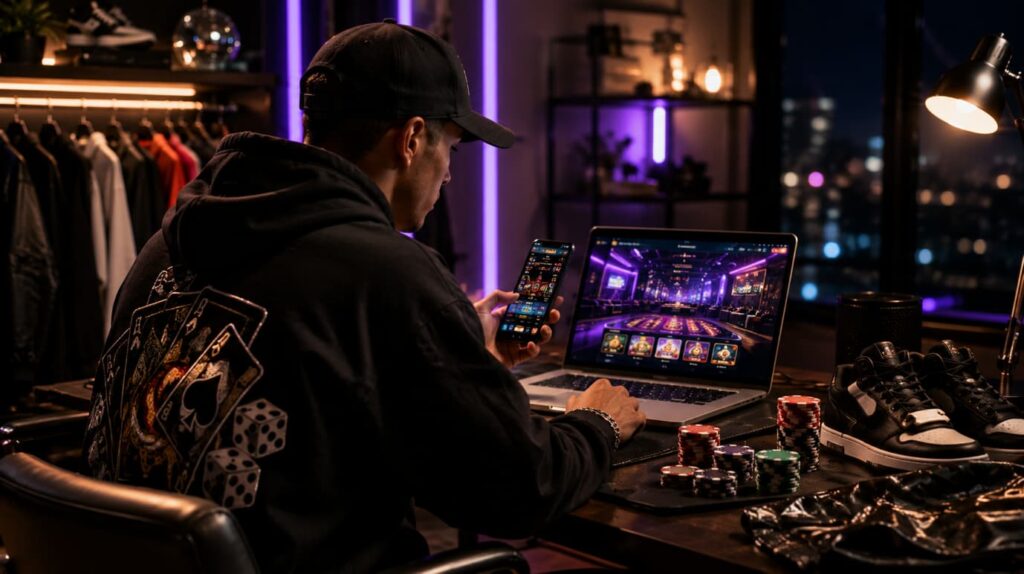
The design teams on both sides are now openly studying each other. The neon gradients of streetwear are borrowed by casino platforms, the countdown timers and capsule-like seasonal events, the reward loops and tiered ladders of the lobby are borrowed by fashion e-commerce.
The overlap is best demonstrated by loyalty design. Streetwear apps provide early-access privileges like gaming platforms provide table upgrades, and both refer to their most loyal customers as VIPs.
The pattern repeats at the Rio Ace online casino, where United Kingdom players pass registration, then sign in via the official website to reach RioAce casino online rooms — one login, and the RioAce casino lobby reads like a moodboard GB designers would pin. Interface and interface-wear, it turns out, are converging on the same palette.